TR2026-090
Understanding Dynamic Compute Allocation in Recurrent Transformers
-
- , "Understanding Dynamic Compute Allocation in Recurrent Transformers", International Conference on Machine Learning (ICML), July 2026.BibTeX TR2026-090 PDF Software Presentation
- @inproceedings{Moosa2026jul,
- author = {{Moosa, Ibraheem Muhammad and Lohit, Suhas and Wang, Ye and Chatterjee, Moitreya and Yin, Wenpeng}},
- title = {{Understanding Dynamic Compute Allocation in Recurrent Transformers}},
- booktitle = {International Conference on Machine Learning (ICML)},
- year = 2026,
- month = jul,
- url = {https://www.merl.com/publications/TR2026-090}
- }
- , "Understanding Dynamic Compute Allocation in Recurrent Transformers", International Conference on Machine Learning (ICML), July 2026.
-
MERL Contacts:
-
Research Areas:



Abstract:
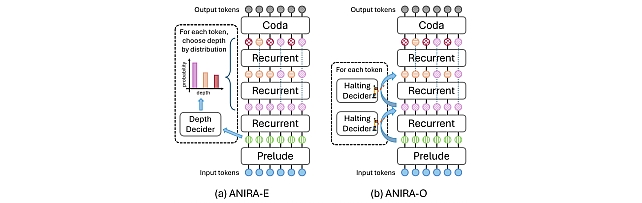
Token-level adaptive computation seeks to reduce inference cost by allocating more computation to harder tokens and less to easier ones. How- ever, prior work is primarily evaluated on natural- language benchmarks using task-level metrics, where token-level difficulty is unobservable and confounded with architectural factors, making it unclear whether compute allocation truly aligns with underlying complexity. We address this gap through three contributions. First, we introduce a complexity-controlled evaluation paradigm using existing algorithmic and synthetic language tasks with parameterized difficulty, enabling direct testing of token-level compute allocation. Second, we propose ANIRA, a unified recur- rent Transformer framework that supports per- token variable-depth computation while isolating compute allocation decisions from other model factors. Third, we use this framework to con- duct a systematic analysis of token-level adaptive computation across alignment with complexity, generalization, and decision timing. Our results show that compute allocation aligned with task complexity can emerge without explicit difficulty supervision, but such alignment does not imply algorithmic generalization: models fail to extrapolate to unseen input sizes despite al- locating additional computation. We further find that early compute decisions rely on static structural cues, whereas online halting more closely tracks algorithmic execution state
Software & Data Downloads
Related News & Events
-
NEWS MERL Presents 4 Main Conference Papers and 6 Workshop Papers at ICML 2026 Date: July 6, 2026 - July 11, 2026
Where: COEX, Seoul, South Korea
MERL Contacts: Moitreya Chatterjee; Anoop Cherian; Stefano Di Cairano; Toshiaki Koike-Akino; Christopher R. Laughman; Jing Liu; Suhas Lohit; Kuan-Chuan Peng; Alexander Schperberg; Ye Wang; Gordon Wichern
Research Areas: Artificial Intelligence, Computer Vision, Machine Learning, Signal ProcessingBrief- MERL researchers are proud to present 4 main conference papers and 6 workshop papers at ICML 2026. ICML, taking place from July 6-11 in Seoul, South Korea, is a premier international conference in machine learning.
Main Conference Papers with MERL Authors:
1. Understanding Dynamic Compute Allocation in Recurrent Transformers by Ibraheem Muhammad Moosa, Suhas Lohit, Ye Wang, Moitreya Chatterjee, and Wenpeng Yin.
2. LLawCo: Learning Laws of Cooperation for Modeling Embodied Multi-Agent Behavior by Qinhong Zhou, Chuang Gan, and Anoop Cherian.
3. Memory-Distilled Selection for Noise-Robust Anomaly Detection by Sirojbek Safarov, Jaewoo Park, Yoon G. Jung, Kuan-Chuan Peng, Wonchul Kim, Seongdeok Bang, and Octavia Camps.
4. Partial Ring Scan: Revisiting Scan Order in Vision State Space Models by Yi-Kuan Hsieh, Kuan-Chuan Peng, Xin Li, Ming-Ching Chang, Yu-Chee Tseng, and Jun-Wei Hsieh.
Workshop Papers with MERL Authors:
1. WISE: Weighted Iterative Society-of-Experts for Multimodal Multi-Agent Debate with Probabilistic Consensus by Anoop Cherian, Suhas Lohit, and Kuan-Chuan Peng. (Workshop on Scalable Learning and Optimization for Efficient Multimodal AI Agents (SCALE))
2. MIRROR: Multisensory Implicit Rejection-sampled RObotic policy by Amisha Bhaskar, Pratap Tokekar, Stefano Di Cairano, and Alexander Schperberg. (Workshop on Structured Probabilistic Inference & Generative Modeling)
3. Reinforced Neural Processes: Memory-Efficient Time-Series Forecasting with a World-Feedback-Trained Memory Policy by Nibraas Khan, Gordon Wichern, and Christopher R. Laughman. (Workshop on Reinforcement Learning from World Feedback (RLxF))
4. Connecting Low-Rank Adapters and Policy Stability in GRPO Fine-Tuning by Antonin Rottman, Francesco Tonin, Yongtao Wu, Toshiaki Koike-Akino, and Volkan Cevher. (Workshop on Connecting Low-rank Representations in AI (CoLorAI))
5. EinSort: Sorting is All We Need for Tensorizing LLM by Toshiaki Koike-Akino, Jing Liu, and Ye Wang. (Workshop on Connecting Low-rank Representations in AI (CoLorAI))
6. Temper and Tilt Lead to SLOP: Reward Hacking Mitigation with Inference-Time Alignment by Ye Wang, and Jing Liu, and Toshiaki Koike-Akino. (Workshop on Agents in the Wild: Safety, Security, and Beyond)
- MERL researchers are proud to present 4 main conference papers and 6 workshop papers at ICML 2026. ICML, taking place from July 6-11 in Seoul, South Korea, is a premier international conference in machine learning.
Related Publication
- @article{Moosa2026feb,
- author = {Moosa, Ibraheem Muhammad and Lohit, Suhas and Wang, Ye and Chatterjee, Moitreya and Yin, Wenpeng},
- title = {{Understanding Dynamic Compute Allocation in Recurrent Transformers}},
- journal = {arXiv},
- year = 2026,
- month = feb,
- url = {https://arxiv.org/abs/2602.08864}
- }