BodyVLA: Embedding Morphology into Transformers for Cross-Robot Policy Learning
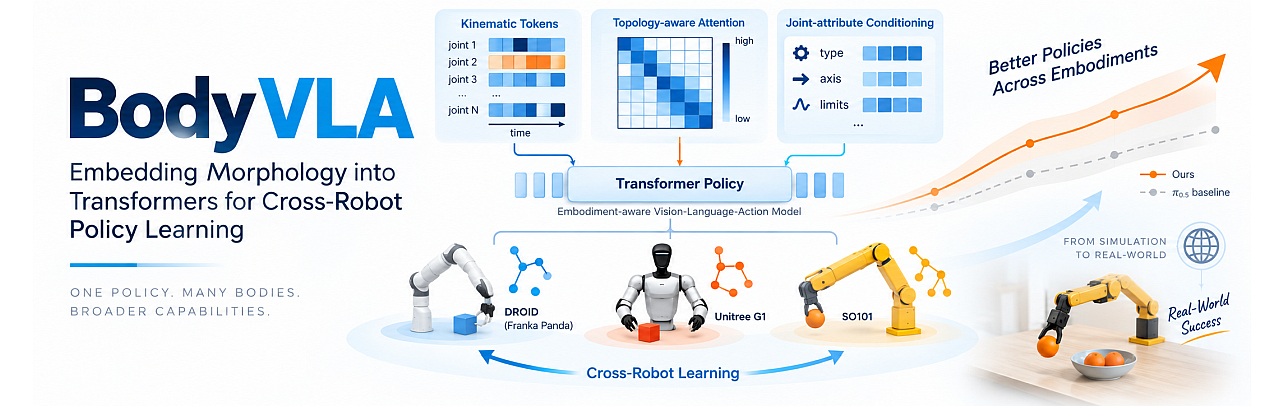
An embodiment-aware transformer policy that injects morphology.
MERL Researchers: Toshiaki Koike-Akino, Kei Suzuki, Jing Liu, Ye Wang, Matthew Brand, Chiori Hori.
PaperAppendix_along_with_Main_Paper.pdf |
VideoSupplemental_Material_Video.mp4 |
Abstract
Cross-robot policy learning—training a single policy to perform well across multiple embodiments—remains a central challenge in robot learning. Transformer-based policies, such as vision-language-action (VLA) models, are typically embodiment-agnostic and must infer kinematic structure purely from observations, which can reduce robustness across embodiments and even limit performance within a single embodiment. We propose an embodiment-aware transformer policy that injects morphology via three mechanisms: (1) kinematic tokens that factorize actions across joints and compress time through per-joint temporal chunking; (2) a topology-aware attention bias that encodes kinematic topology as an inductive bias in self-attention, encouraging message passing along kinematic edges; and (3) joint-attribute conditioning that augments topology with per-joint descriptors to capture semantics beyond connectivity. Across a range of embodiments, this structured integration consistently improves performance over a vanilla p0.5 VLA baseline, indicating improved robustness both within an embodiment and across embodiments.
Method
We propose an embodiment-aware transformer policy through a structured morphology interface consisting of three components:
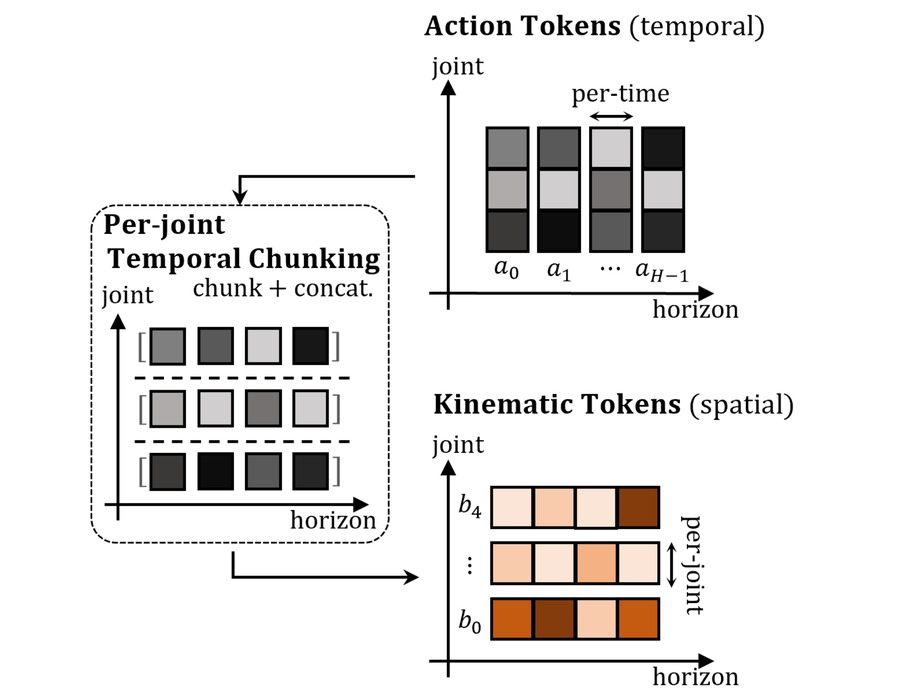
(1) Kinematic tokens provide a joint-wise interface for the VLA action policy. While the standard action tokens retain temporal structure, kinematic tokens compress the horizon into per-joint summaries, emphasizing cross-joint (spatial) structure and enabling topology/semantics embedding.
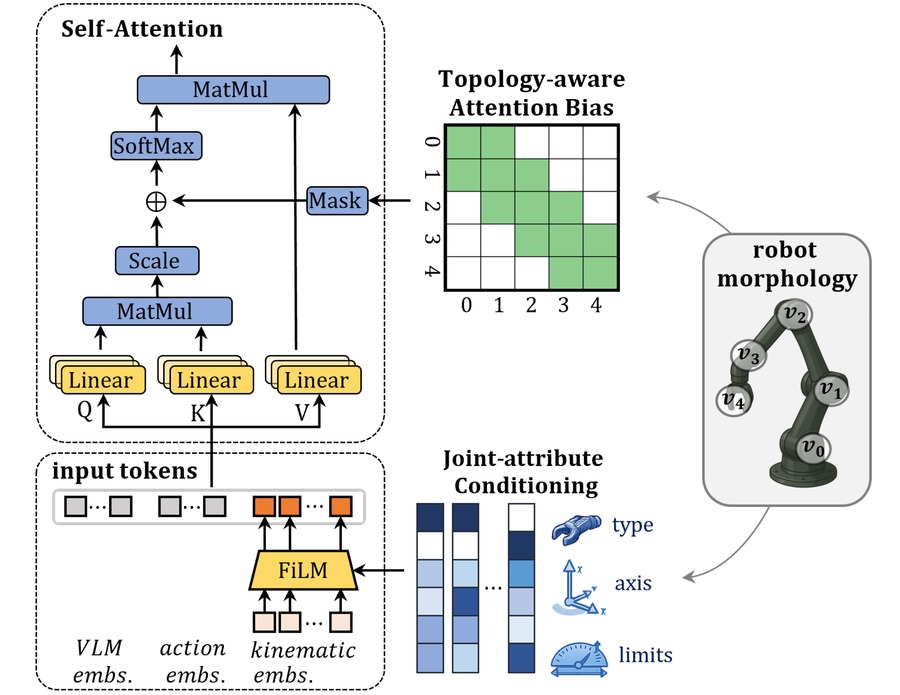
We embed kinematic topology and semantics in two ways: (2) a topology-aware attention bias injects local kinematic message passing while preserving global coordination through a local/global schedule, and (3) FiLM conditions kinematic-token embeddings on per-joint descriptors to disambiguate joint roles beyond connectivity.
Results
DROID Results
Each component improves performance, with the best result achieved by combining all three (KT+Mix+FiLM).
Our method yields significantly large gains over the baseline on Task 2 and Task 3, improving success rates by 5-fold and 2.3-fold, respectively.
DROID rollout videos: π0.5 Baseline vs. Ours
DROID Task 1
π0.5 Baseline: ✅ Success |
Ours: ❌ Failure |
DROID Task 2
π0.5 Baseline: ❌ Failure |
Ours: ✅ Success |
DROID Task 3
π0.5 Baseline: ❌ Failure |
Ours: ✅ Success |
SO101 and Unitree G1 Simulation Rollouts
Ours — SO101: ✅ Success |
Ours — Unitree G1 Dex1: ✅ Success |
DROID—SO101 Joint Training and Real-World Experiment
We evaluate DROID—SO101 joint-trained policies on a real SO101 robot.
| Method | Config. 1 | Config. 2 | Config. 3 | Total |
|---|---|---|---|---|
| p0.5 Baseline | 0 | 3 | 1 | 4 |
| Ours | 11 | 9 | 13 | 33 |
| Improvement | +11 | +6 | +12 | +29 |
SO101 rollout videos
10 trials - Baseline 0 oranges - Ours 11 oranges
π0.5 Baseline
|
Ours
|
10 trials - Baseline 3 oranges - Ours 9 oranges
π0.5 Baseline
|
Ours
|
10 trials - Baseline 1 orange - Ours 13 oranges
π0.5 Baseline
|
Ours
|
Ablation Studies
To validate the effectiveness of our design choices, we study whether performance depends on (i) the kinematic token chunk size G, (ii) auxiliary kinematic tokens (AKT), and (iii) bias initialization for the Soft-Mask variant.
Using a single kinematic token chunk (G=1) achieves the best Avg SR.
Adding auxiliary kinematic tokens consistently improves Avg SR across all masking choices.
Mix is the best soft-mask initialization (28.1 Avg SR),while Ours reaches 36.9 Avg SR,showing a +8.8 point improvement over the strongest soft-mask variant.
Citation
-
, "Embedding Morphology into Transformers for Cross-Robot Policy Learning", arXiv, February 2026.
BibTeX arXiv
- @article{Suzuki2026feb,
- author = {Suzuki, Kei and Liu, Jing and Wang, Ye and Hori, Chiori and Brand, Matthew and Romeres, Diego and Koike-Akino, Toshiaki},
- title = {{Embedding Morphology into Transformers for Cross-Robot Policy Learning}},
- booktitle = {arXiv},
- year = 2026,
- month = feb,
- url = {https://arxiv.org/abs/2603.00182}
- }
MERL Publications
- , "Embedding Morphology into Transformers for Cross-Robot Policy Learning", International Conference on Learning Representations (ICLR) Workshop, April 2026.BibTeX TR2026-048 PDF
- @inproceedings{Suzuki2026apr,
- author = {Suzuki, Kei and Liu, Jing and Wang, Ye and Hori, Chiori and Brand, Matthew and Romeres, Diego and Koike-Akino, Toshiaki},
- title = {{Embedding Morphology into Transformers for Cross-Robot Policy Learning}},
- booktitle = {International Conference on Learning Representations (ICLR) Workshop on Efficient Spatial Reasoning},
- year = 2026,
- month = apr,
- url = {https://www.merl.com/publications/TR2026-048}
- }